
How to Cure Insomnia in 12 Minutes
-
Aug, 17, 2026
If you have ever searched “how to cure insomnia in 12 minutes,” you are probably looking for a quick way to switch off your thoughts and fall asleep.
The reality is that there is no scientifically guaranteed method that can cure insomnia in exactly 12 minutes. Persistent insomnia is a sleep disorder that can have many causes, including stress, anxiety, irregular sleep schedules, caffeine, alcohol, shift work, pain and other health conditions.
However, you can use a 12-minute relaxation routine to reduce stimulation before bedtime and create better conditions for sleep.
The key is not to force yourself to sleep. Instead, the aim is to help your body and mind move from an alert state towards relaxation.
Can You Really Cure Insomnia in 12 Minutes?
Probably not if you mean permanently cure insomnia.
Insomnia can be short-term or long-term. The NHS describes long-term insomnia as sleep problems lasting three months or longer. Persistent insomnia may require assessment and treatment rather than a single bedtime technique.
A 12-minute routine can nevertheless be useful for:
- Calming racing thoughts
- Reducing bedtime tension
- Slowing down your breathing
- Relaxing tense muscles
- Creating a consistent pre-sleep routine
- Taking your attention away from worries
- Preparing your body for sleep
Think of the 12 minutes as a sleep preparation routine, not a guaranteed cure.
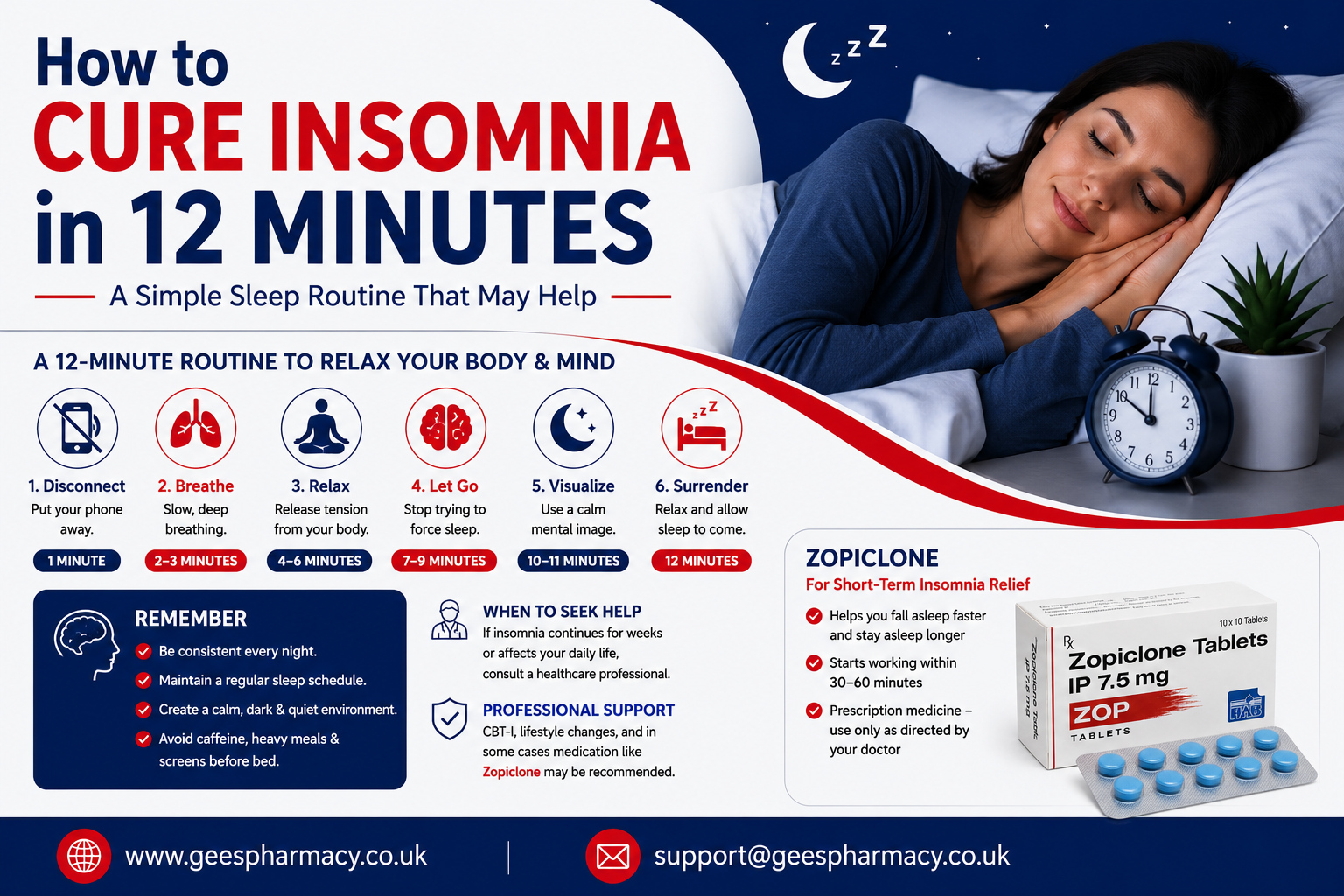
The 12-Minute Insomnia Routine
If you are lying awake tonight, try the following routine.
Minute 1: Put Your Phone Away
Start by removing common sources of stimulation.
Put your phone on silent or place it somewhere you cannot easily reach it. Turn off unnecessary notifications and avoid checking the time repeatedly.
The NHS recommends avoiding phones and other devices immediately before bedtime because they can make you more alert.
The objective is simple:
No scrolling. No emails. No social media. No checking the clock.
Give your brain fewer reasons to stay alert.
Minutes 2-3: Make Your Breathing Slower
Lie comfortably and bring your attention to your breathing.
Take a comfortable, slow breath in and allow the breath out to be gentle and unforced.
You don’t need to use an extreme breathing pattern or hold your breath for a long time.
Simply focus on:
Slow inhale → gentle exhale → relax.
Repeat this for approximately two minutes.
Breathing exercises are among the relaxation techniques commonly incorporated into CBT-I and other insomnia approaches.
Minutes 4-6: Relax Your Muscles
Now move your attention through your body.
Start with your:
- Forehead
- Jaw
- Shoulders
- Arms
- Hands
- Chest
- Stomach
- Legs
- Feet
Notice where you are holding tension.
Relax each area deliberately.
For example:
Unclench your jaw.
Drop your shoulders.
Relax your hands.
Let your legs become heavy.
Progressive muscle relaxation is one technique used in behavioural approaches to insomnia and can help reduce physical tension associated with difficulty sleeping.
Minutes 7-9: Stop Trying to Force Sleep
This is one of the most important parts of the routine.
If you keep thinking:
“I have to fall asleep now.”
you may become increasingly frustrated when sleep does not happen immediately.
Instead, change the goal.
Don’t try to force sleep.
Try to rest quietly.
The NHS’s sleep guidance similarly advises people not to force sleep when they are lying awake.
Allow your thoughts to come and go without trying to solve every problem tonight.
Minutes 10-11: Use a Simple Mental Image
Choose something calm and repetitive.
For example, imagine:
- Walking slowly along a quiet beach
- Sitting beside a peaceful lake
- Watching gentle rain through a window
- Lying beneath a warm blanket
- Walking through a quiet forest
Keep the image simple.
You don’t need to create an elaborate story.
If another thought appears, gently return your attention to the image.
Minute 12: Let Go of the Goal
At the end of the 12 minutes, don’t ask:
“Am I asleep yet?”
That question can restart the cycle of frustration.
Instead, continue resting comfortably.
If you’re becoming increasingly frustrated while lying awake, getting out of bed for a quiet activity and returning when you feel sleepy can be part of stimulus-control approaches used for insomnia.
Why Can a 12-Minute Routine Help?
The routine isn’t a magic cure.
Its purpose is to remove some of the things that can interfere with sleep.
For example:
Phone → stimulation
Worry → mental alertness
Muscle tension → physical alertness
Clock watching → anxiety about sleep
Forcing sleep → frustration
Replacing these behaviours with relaxation can create a more favourable environment for sleep.
This is consistent with the broader principles used in CBT-I, which addresses thoughts and behaviours that can contribute to insomnia.
What If the 12-Minute Method Doesn’t Work?
Don’t assume that you’ve failed.
One difficult night does not necessarily mean you have chronic insomnia.
Sleep can be affected by:
- Stress
- Anxiety
- Travel
- Changes in routine
- Caffeine
- Alcohol
- Nicotine
- Work schedules
- Illness
- Pain
- Environmental noise
- An uncomfortable bedroom
These are among the recognised contributors to insomnia.
If you regularly struggle to sleep, the answer may require more than a bedtime relaxation exercise.
7 Habits That Can Help With Insomnia
A 12-minute routine works best when combined with healthy sleep habits.
1. Keep the Same Wake-Up Time
Try to wake up at approximately the same time every day.
A consistent schedule can help your body establish a regular sleep-wake rhythm.
2. Go to Bed When You’re Sleepy
Instead of going to bed extremely early simply because you want more sleep, try to follow your body’s natural sleepiness.
The NHS recommends going to bed when you feel sleepy.
3. Reduce Caffeine in the Evening
Coffee, tea, energy drinks and other caffeinated products can interfere with sleep.
If caffeine affects your sleep, avoid it later in the day.
4. Create a Relaxing Bedtime Routine
Reading, listening to calm music or taking a warm bath can help create a transition between daytime activity and bedtime.
The NHS recommends relaxing for at least an hour before bed.
5. Make Your Bedroom Comfortable
A bedroom that is dark, quiet and comfortable may make sleeping easier.
6. Avoid Long Daytime Naps
Long naps can reduce your sleep drive at night and make it more difficult to fall asleep.
7. Don’t Sleep In After a Bad Night
It can be tempting to stay in bed for several extra hours after a poor night’s sleep.
However, maintaining a regular schedule can help reinforce a consistent sleep pattern.
Can Breathing Exercises Cure Insomnia?
Breathing exercises can be useful for relaxation, but they should not be described as a guaranteed cure for insomnia.
They may be particularly helpful when your difficulty sleeping is accompanied by:
- Racing thoughts
- Physical tension
- Stress
- Bedtime anxiety
- Difficulty switching off
Relaxation techniques, including breathing exercises and progressive muscle relaxation, are commonly used as part of CBT-I.
However, persistent insomnia may require a structured treatment programme.
What Is CBT-I?
CBT-I stands for Cognitive Behavioural Therapy for Insomnia.
It is a structured treatment that focuses on the relationship between your thoughts, behaviours and sleep.
CBT-I can include:
- Sleep education
- Stimulus control
- Sleep restriction or sleep compression
- Cognitive restructuring
- Relaxation techniques
- Sleep hygiene
It is considered a first-line treatment for chronic insomnia by sleep specialists and does not rely on medication.
The NHS also states that CBT can help with sleep problems such as insomnia and may be delivered face-to-face or through online programmes.
When Should You Speak to a Doctor About Insomnia?
A quick relaxation technique may be enough for occasional sleep difficulties.
However, speak with a GP if:
- Your sleep problems continue for months
- Changing your sleep habits hasn’t helped
- Insomnia is affecting your everyday life
- You regularly feel exhausted during the day
- You have difficulty concentrating because of poor sleep
- You suspect another sleep disorder
The NHS specifically recommends seeking medical advice when insomnia persists or significantly affects daily life.
A GP can investigate potential causes and determine whether you may benefit from CBT, a sleep clinic or another treatment.
What About Sleeping Tablets?
Sleeping medicines may sometimes be used for severe short-term insomnia, but they are not generally considered a long-term solution.
The NHS says sleeping pills are now rarely prescribed for insomnia because they can cause serious side effects and dependence. When prescribed, they are generally used only for a short period when insomnia is particularly severe or other treatments have not worked.
This is why behavioural approaches such as CBT-I are important for people with persistent insomnia.
What About Zopiclone for Insomnia?
Zopiclone is a prescription sleeping medicine that may be used for short-term insomnia in appropriate patients.
It can help reduce difficulties with falling asleep and staying asleep, but it should not be considered a permanent cure for chronic insomnia.
If a doctor prescribes zopiclone, it should be taken exactly according to the prescription.
People searching online for phrases such as “buy zopiclone, zopiclone buy, buy zopiclone online uk, zopiclone online uk, buying zopiclone or “zopiclone next day” should remember that prescription medicines should only be obtained through legitimate, authorised channels and used under appropriate medical supervision.
For long-term insomnia, discussing CBT-I or another evidence-based treatment with a healthcare professional may be more appropriate than relying on sleeping medication.
How to Fall Asleep Faster Without Medication
If your goal is to fall asleep faster tonight, focus on reducing stimulation rather than searching for a guaranteed instant cure.
Try this simple sequence:
Turn off your phone.
↓
Dim the lights.
↓
Slow your breathing.
↓
Relax your muscles.
↓
Stop checking the clock.
↓
Let your thoughts pass without engaging with them.
↓
Allow sleep to happen naturally.
This approach may take longer than 12 minutes, and that’s completely normal.
The goal is not to beat a stopwatch.
The goal is to create conditions in which sleep becomes easier.
Frequently Asked Questions
Can you really cure insomnia in 12 minutes?
There is no reliable evidence that chronic insomnia can be permanently cured in exactly 12 minutes. A short relaxation routine may help some people become calmer and prepare for sleep, but persistent insomnia usually requires a broader approach.
What is the fastest way to fall asleep?
There is no single technique that works for everyone. A calm environment, consistent sleep schedule, relaxation and avoiding stimulating activities before bed can improve the chances of falling asleep.
Does the 4-7-8 breathing method cure insomnia?
Breathing exercises may help some people relax, but they should not be described as a guaranteed cure for insomnia.
What should I do if I can’t sleep after 20 minutes?
Rather than remaining in bed becoming increasingly frustrated, a stimulus-control approach may involve getting up and doing a quiet activity until you feel sleepy before returning to bed.
Is CBT-I better than sleeping tablets?
CBT-I is an evidence-based treatment for chronic insomnia and is generally preferred as a long-term approach because it targets the thoughts and behaviours contributing to insomnia rather than relying on medication.
Can I cure insomnia naturally?
Some cases of insomnia improve when sleep habits and routines are changed. Persistent insomnia, however, may require professional assessment and treatment.
Final Thoughts
The search phrase “how to cure insomnia in 12 minutes” suggests that people want an immediate solution to a frustrating problem.
While there is no guaranteed 12-minute cure, a short relaxation routine can be a useful way to prepare your body and mind for sleep.
Start with the basics: maintain a regular sleep schedule, create a relaxing bedtime routine, reduce evening stimulation, avoid excessive caffeine and give yourself time to unwind.
If insomnia continues for weeks or months, don’t keep searching for increasingly quick fixes. Speak with a healthcare professional and consider evidence-based options such as CBT-I.
The best solution to insomnia isn’t necessarily the fastest one. It’s the approach that addresses why you’re struggling to sleep in the first place.